
There's a reason a wall-saw operator doesn't show up to do a floor job. The cuts look superficially similar — a clean line through the slab — but the machines, the rigging, the depths and the constraints are different. Here's the short version.
Floor saw
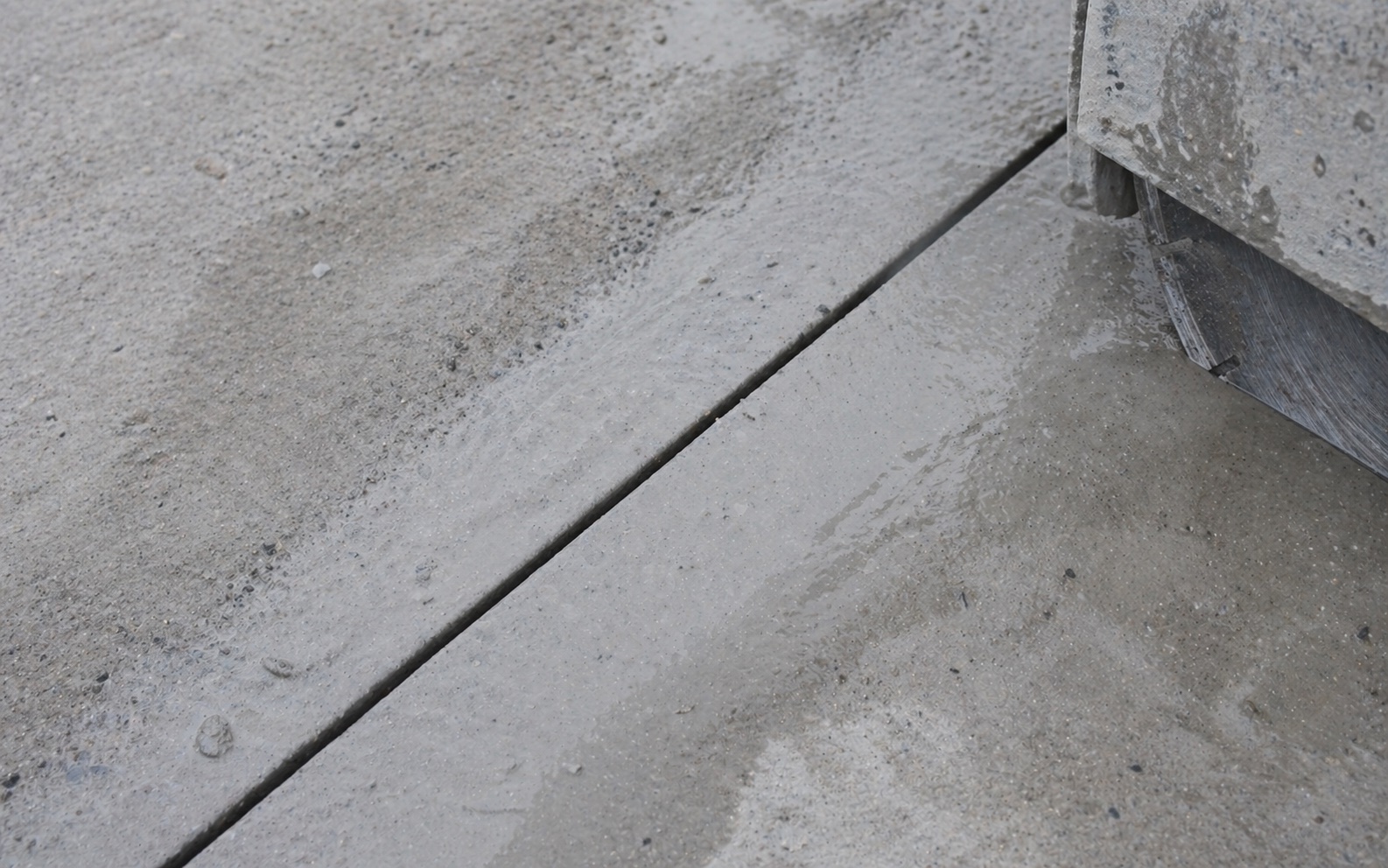
A floor saw is a wheeled, walk-behind unit running a single circular diamond blade in the vertical plane. The blade drops down into a horizontal slab. Think of it as the concrete equivalent of a chop-saw on wheels.
What it's for
- Long-run expansion joints in industrial floors, warehouses, distribution centres.
- Demolition apertures cut into existing slabs.
- Service trenches in car parks or external slabs.
- Anywhere you can stand on top of the slab and walk the saw across it.
Depth
Up to ~525mm in a single pass with a heavy floor saw. Most jobs sit comfortably in the 100-300mm band.
Wall saw
A wall saw is a track-mounted blade. The track bolts onto the face of a wall (or upturned onto a ceiling), and a hydraulically-driven head rides along it carrying a circular blade. Because it's rigged, not handheld, it can cut precise lines through vertical surfaces — including through reinforcement.
What it's for
- Cutting new openings in existing walls — doorways, MEP risers, structural apertures.
- Cutting bearing walls where vibration has to be controlled.
- Overhead cuts where a handheld saw isn't safe.
Depth
Up to ~730mm with the larger Tyrolit / Husqvarna heads. Fully through most domestic and commercial walls in a single pass.
Wire saw
A wire saw uses a continuous loop of diamond-impregnated wire, threaded through pre-drilled access holes and pulled around the section being cut by hydraulic drive wheels. The wire grinds its way through anything it can be looped around — concrete, rebar, even steel beams cast into the slab.
What it's for
- Mass concrete sections too thick for a wall saw.
- Bridge beams, pile caps, retaining walls, pre-stressed sections.
- Awkward shapes — anywhere a straight rigid blade can't reach.
- Heavy demolition cuts where you need to extract whole sections cleanly.
Depth
Effectively unlimited — 1200mm and well beyond. The constraint becomes "can we route the wire", not "can the wire reach".
Floor saw walks across the slab. Wall saw rides on a track. Wire saw loops around the section. Pick by the access, not the size.
Wet vs dry cutting
All three cut wet by default — water cools the blade or wire and flushes slurry away. Dry cutting is possible for some floor and handheld work but produces silica dust, which has to be vacuum-extracted at source under HSE rules. We'd rather plumb a hose than fight a dust-extractor; wet is cleaner, quieter and faster on most sites.
How to know which you need
Three quick tests:
- Is the cut horizontal (top of a slab)? Floor saw.
- Is it vertical or overhead, on a wall up to ~700mm thick? Wall saw.
- Is it through mass concrete, a bridge, or an awkward shape? Wire saw.
If you're not sure, send a photo and the rough thickness — we'll tell you which machine fits and price it accordingly.
Got a cut to plan? Send the brief → · or read what to send for a fast quote.