
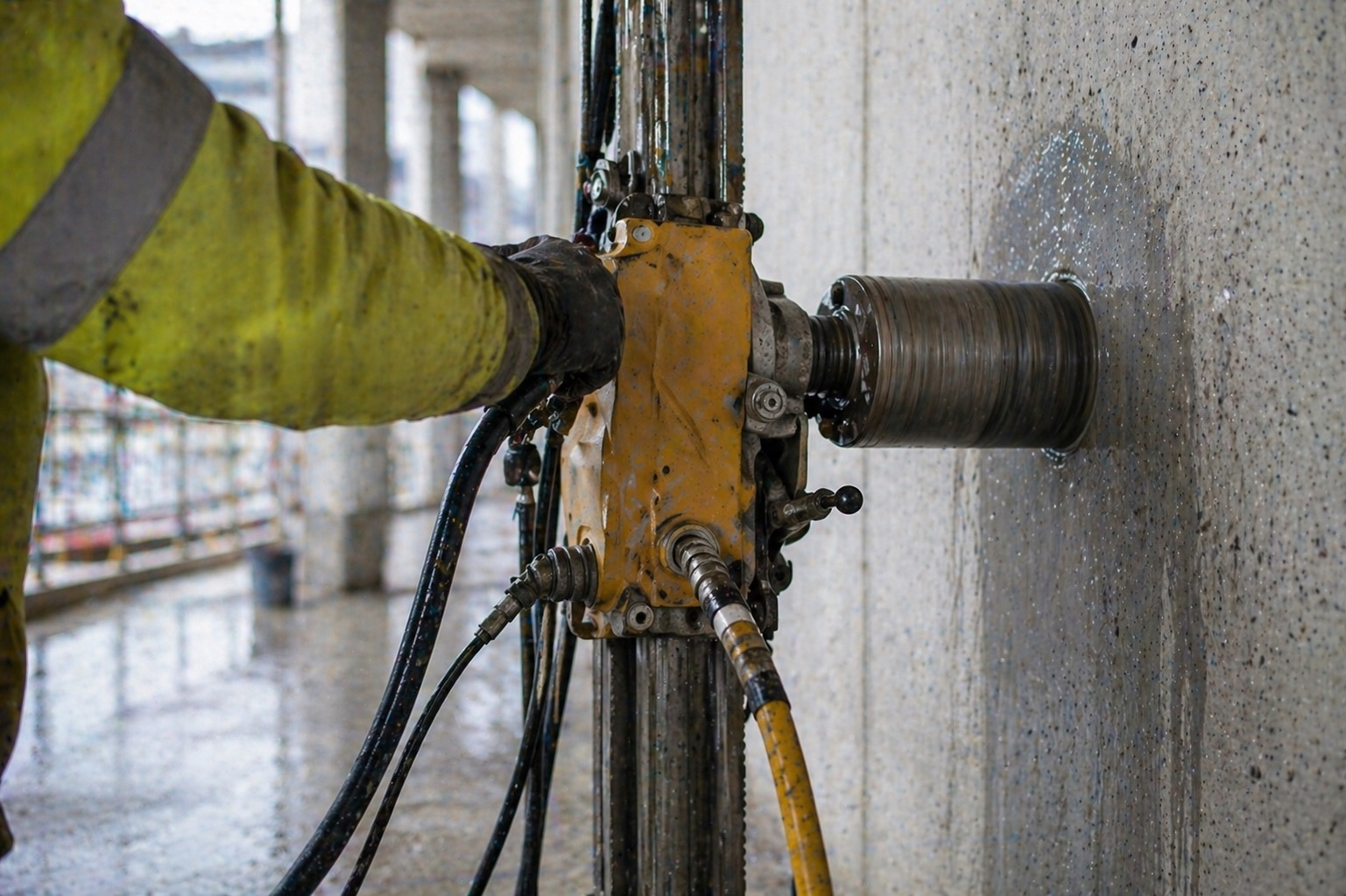
If you've only ever used a hammer drill, it's tempting to assume any hole is just a bigger version of the same job. It isn't. Diamond drilling and percussion drilling are different processes — different cutting actions, different machines, different consequences for the slab.
What percussion drilling is
Percussion drilling — what most people mean when they say "hammer drill" or "SDS" — combines rotation with a fast hammer action. A tungsten-carbide bit rotates while being thumped against the substrate hundreds of times a second. The hammering chips away at the concrete; the rotation clears the dust and edges the hole.
It's the workhorse for plug holes, fixings, and small services. The kit is cheap, portable, and runs off a 110 V or battery supply. For a 10mm hole through a partition wall, it's perfect.
What diamond drilling is
Diamond drilling uses a hollow steel core barrel tipped with industrial diamond segments. The barrel rotates fast, and water (or sometimes vacuum-extracted dust) cools the cutting face and flushes out slurry. The diamonds don't smash the concrete — they grind it away. The hole comes out clean, round, and precise. The slab next to it is undisturbed.
Where percussion fits
- Small holes — typically up to ~25mm.
- Light-duty fixings, plugs, brackets.
- Substrate where vibration is acceptable and rebar isn't a major concern.
- Quick, cheap, low-stakes work — site offices, partition walls, a one-off hole for a hose.
Where diamond drilling fits
- Anything bigger than ~25mm — and it scales cleanly all the way to 1000mm Ø service risers.
- Reinforced or post-tensioned concrete, where percussion bits would either bounce off rebar or, worse, crack the slab.
- Vibration-sensitive sites — live floors below, listed buildings, hospitals, working datacentres.
- Anywhere the finish matters — clean cut, no spalling, ready for sleeving and fire-stopping.
- Where slurry and dust have to be controlled, not just tolerated.
If the slab matters, the hole matters. Diamond drilling treats it that way.
The grey zone
There's a band of jobs — say, 25-50mm holes through ordinary domestic concrete — where either method could work. Percussion is faster to set up; diamond is cleaner and quieter. The right call usually comes down to two things: can the surrounding slab tolerate vibration, and does the finished hole need to be precise enough to sleeve or fire-stop?
If the answer to either is "yes", diamond wins.
What to do if you're not sure
Send a phone photo of the slab, the hole size you need, and a rough idea of access. We'll come back with a price, and — when the job genuinely doesn't need diamond drilling — we'll tell you. We'd rather lose a small job than oversell you on the wrong technique.
Need a price? Send the brief → — it's fastest if you include a postcode, photo and the size of the hole you're after. We covered that here.