
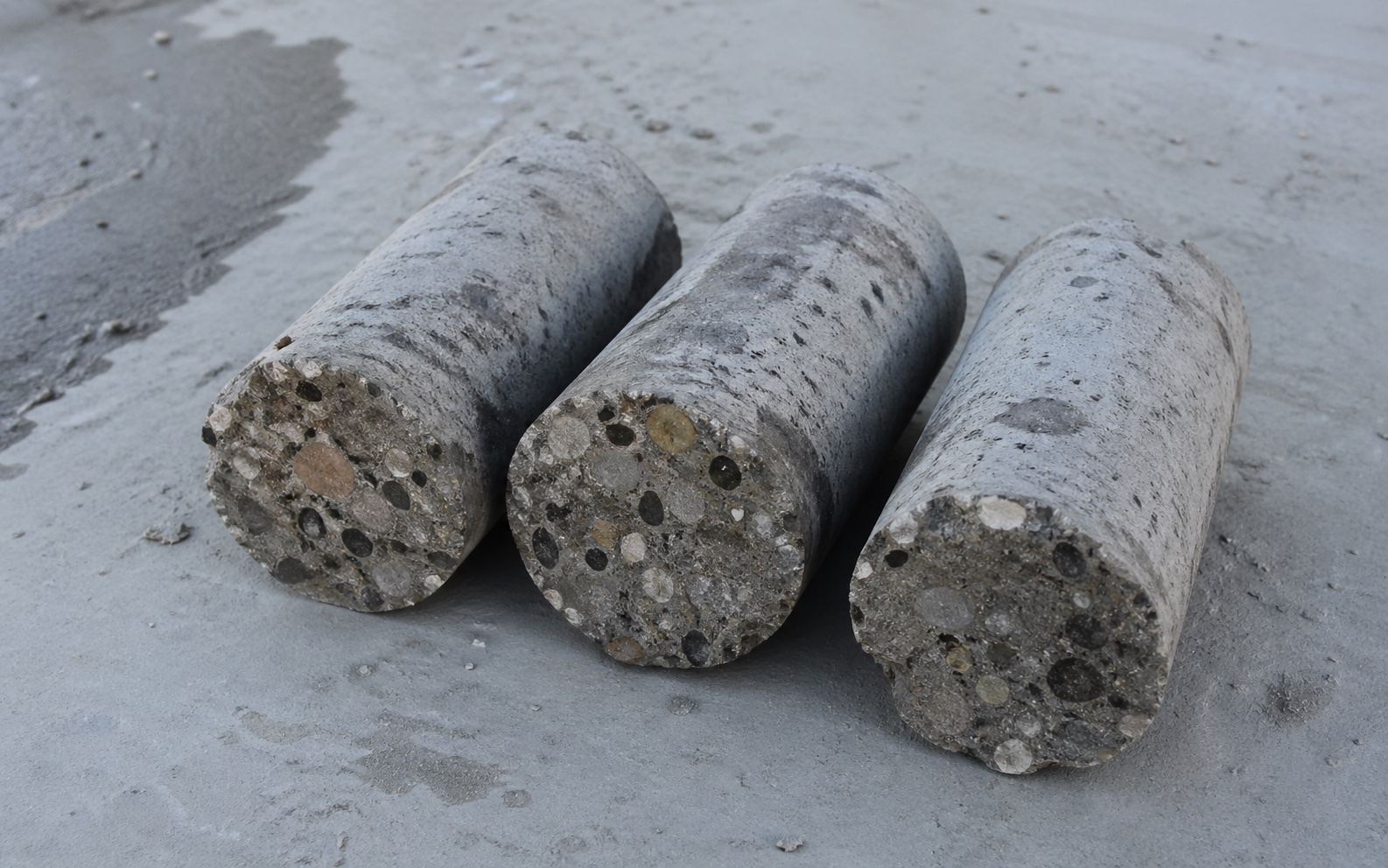
Concrete looks solid. It almost never is. Inside any slab cast since the 1950s you'll find rebar, conduits, often post-tension cables, sometimes voids. Scanning is how we find out what's in your slab before the bit does.
What's actually in a slab
Depending on the building's age, sector and engineer's spec, you might find any of:
- Rebar. Steel reinforcement bars, usually in a grid. Standard for any structural concrete.
- Post-tension (PT) cables. Tensioned steel strands cast into the slab to keep it in compression. Common in slabs cast since the 1980s, especially in commercial towers, car parks and transfer slabs.
- Services and conduits. Electrical, MEP, sprinkler runs, sometimes data, sometimes gas — cast into the slab during the pour.
- Voids. Cast-in services, drainage, deliberate voids in waffle/bubbledeck slabs.
You don't always need to know every detail. You absolutely need to know before a 200mm bit lands somewhere it shouldn't.
Rebar detection — the first scan
For most jobs, a hand-held rebar scanner is the first move. It's a small unit that detects ferrous metal under the surface, gives you depth and position, and lets us mark the slab up before we set the rig. Quick — 5 to 10 minutes for a typical hole position.
What it gets us:
- The rebar grid layout, so we can shift the hole a few mm one way or the other to miss it cleanly.
- Depth confirmation — sometimes the rebar's deeper than the engineer's drawing claims.
- An early warning if the slab isn't what the drawing says it is.
GPR — when we go deeper
Ground-penetrating radar is the next step up. It uses radar waves to map what's in the slab in much more detail — including non-ferrous services, voids, and crucially, post-tension cables. Slower than a rebar scan, more interpretive (a trained operator reads the trace), but essential when the stakes are higher.
We bring GPR in for:
- Any post-tensioned slab. Always.
- Transfer slabs where the engineer's drawings are old or incomplete.
- Refurbs of unknown buildings where as-built records are missing.
- Anywhere a cut conduit could mean shutting down a working building.
Cutting a post-tension cable on a live slab releases tension violently. It's the single avoidable mistake that ends careers.
The PT-cable rule
Post-tensioning is what makes thin modern slabs span large distances. The cables are under enormous load — typically 80% of the steel's yield strength. Cutting one releases that energy in a fraction of a second: spalled concrete, recoiling cable, structural compromise around the cut.
That's why we don't drill any slab we suspect is post-tensioned without scanning first. No exceptions, no "we'll be careful". The scan is what makes "careful" possible in the first place.
When we can move on without scanning
Not every job needs a scan. We're comfortable skipping it when:
- The work is in non-structural blockwork or partition walls.
- You've supplied as-built drawings that show the rebar layout and we trust them.
- The hole is small and there's a known clear zone.
- We've worked the same building before and have records.
If any of those don't apply, we scan. It's a small line on the quote. The alternative is much more expensive.
What it costs you as the client
For a typical job, scanning adds an hour or two of crew time and shows up as a clearly itemised line on the quote. On large or unknown sites, GPR work can be a full half-day with a specialist operator — but on those jobs, you'd want it anyway.
If you've sent us a brief and we've quoted scanning into it, that's not us padding the price. It's us telling you we're doing the job properly.
Got a slab to drill? Send the brief → · or read why we choose diamond drilling for structural work.