
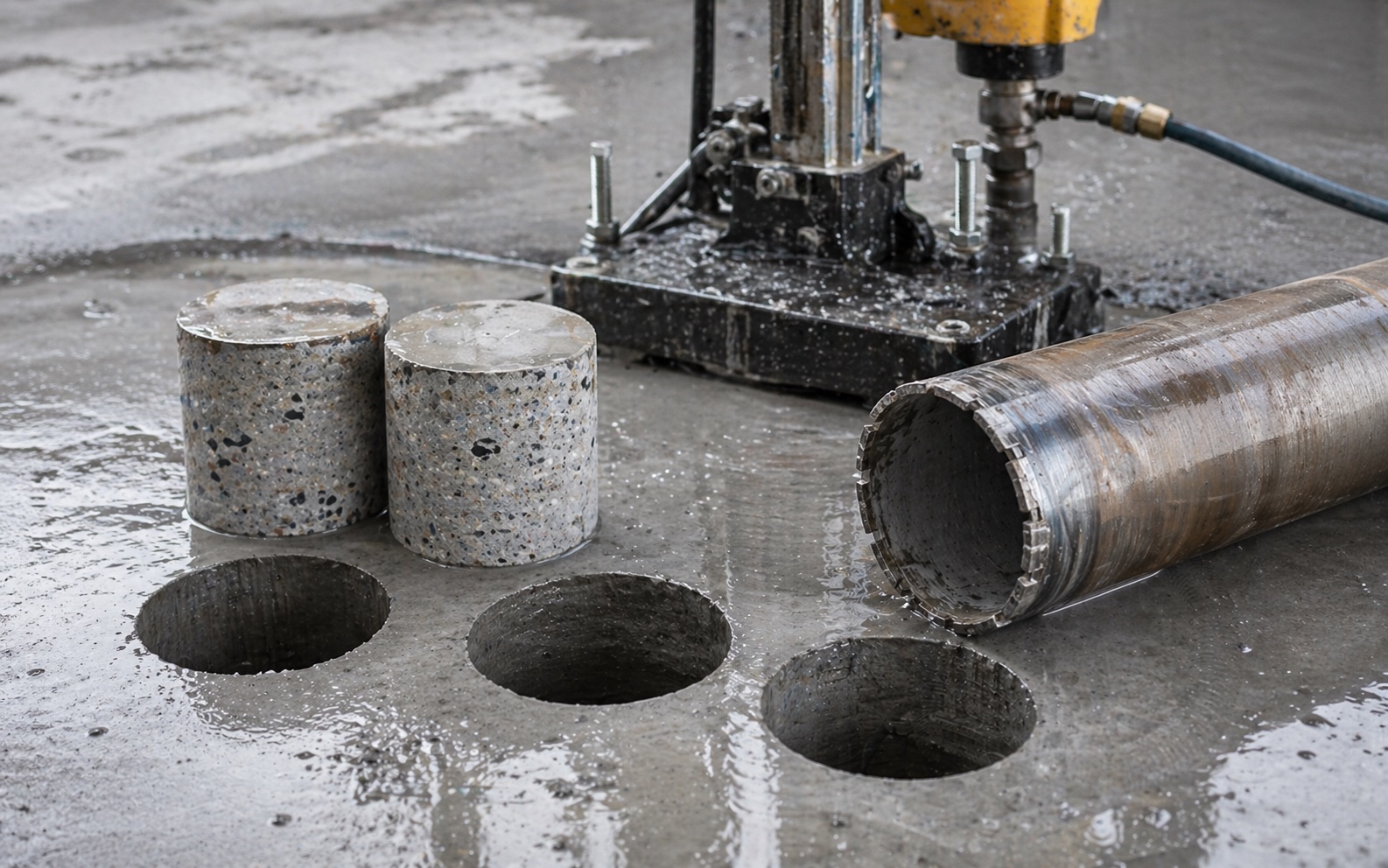
If you've watched a diamond core drill running, you've probably seen water gushing out of the bit and slurry running across the slab. That's wet drilling, and it's our default. But there are jobs where dry drilling is the better — sometimes the only — option. Here's how to tell.
Wet drilling
Water is fed into the centre of the diamond core barrel as it spins. It cools the diamond segments (which would otherwise glaze and lose cutting efficiency), and it flushes the cut material — slurry — back out of the hole.
What it gives you:
- Cleaner air. The dust is captured at the cutting face before it ever becomes airborne. Massive PPE and air-quality win.
- Quieter cut. Water dampens the cutting noise — useful in occupied buildings.
- Longer bit life. Cool diamonds cut better and last longer.
- Faster cutting on big bores. Anything over ~100mm is much more efficient wet.
The cost: you need a water supply on site (or a bowser the crew brings), and you need somewhere for the slurry to go — a drain, a slurry-extraction pump, or a containment bund.
Dry drilling
Dry drilling skips the water and instead relies on a vacuum extractor pulling dust away from the cutting face as it's generated. The kit is more compact, the setup is faster, and you don't have to plumb anything in.
What it suits:
- Small bores — typically up to 50mm.
- Locations where water genuinely can't go: live data centres, cold stores, electrical rooms, finished spaces with sensitive flooring below.
- Fast pop-in jobs where the wet kit setup time isn't justified.
The cost: bit life is shorter, cutting is slower over ~50mm, and the dust extraction is non-negotiable. Which brings us to the bit nobody loves talking about.
The silica rule
Cutting concrete generates respirable crystalline silica (RCS) — fine dust particles that get past the body's natural filters and lodge deep in the lungs. Long-term exposure causes silicosis and is linked to lung cancer. The HSE has been tightening enforcement for years.
The current UK Workplace Exposure Limit (WEL) for RCS is 0.1 mg/m³ averaged over 8 hours — and there's serious appetite to lower it further. The HSE's Control of Substances Hazardous to Health Regulations 2002 (CoSHH) require employers to control exposure at source, not at the point of breathing.
In practice that means:
- Wet cutting where possible (water suppresses dust at source).
- Dust extraction at the bit head where wet isn't possible (a M-class or H-class vacuum, ducted to the cutting point).
- RPE (respiratory protective equipment) as a last line of defence, never the first.
If a contractor's dry-cutting on your site without dust extraction at source, they're not just being lazy — they're breaking the rules.
Which we use when
Our default is wet. We'll quote dry only when the site genuinely can't take water — or when the bore is small enough that dry plus extraction is the cleaner answer. If we're proposing dry, we're bringing extraction; if we're proposing wet, we'll have either a drain plan or full extraction.
What this means for you as the client
- If the site has water and a drain: wet drilling is the cleanest, fastest answer.
- If the site can't take water (live electricals, cold rooms, finished floors below): dry drilling with extraction.
- Either way, the slab should be handed back without dust hanging in the air.
Read more on why we scan before we drill, or why diamond drilling beats percussion for structural work.
Got a job and not sure which method fits? Send the brief → · we'll tell you in the quote.